




JAKARTA - Asia-Pacific accounted for nine of the world’s 10 busiest airport pairs in 2025, IATA said on July 16.
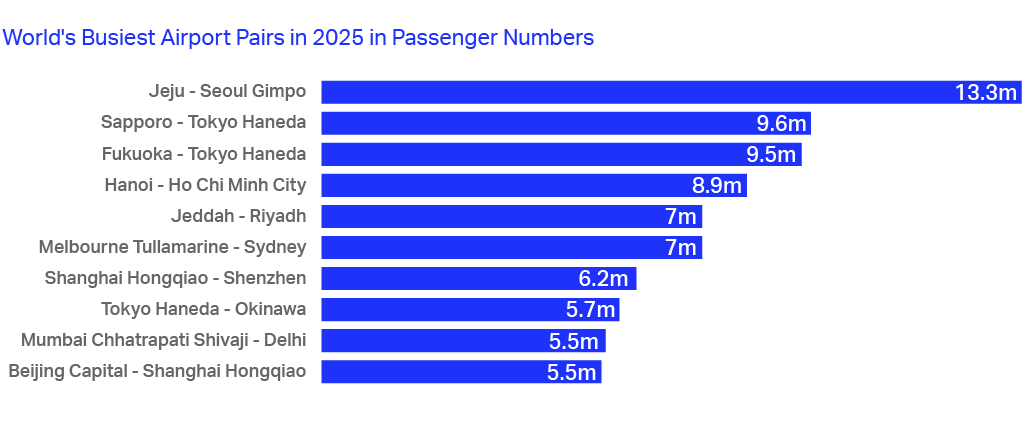
The International Air Transport Association’s latest World Air Transport Statistics placed Jeju International Airport–Seoul Gimpo International Airport first worldwide with 13.3 million passengers.
Every connection in the top 10 was domestic. Jeddah–Riyadh, which carried 7 million passengers, was the only airport pair outside Asia-Pacific.
Vietnam’s Hanoi–Ho Chi Minh City connection ranked fourth globally with 8.9 million passengers, according to IATA’s airport-pair ranking. It followed Jeju–Seoul Gimpo and two Japanese routes linking Tokyo Haneda with Sapporo and Fukuoka. IATA also recorded 80.9 million scheduled passenger journeys originating or terminating in Vietnam in 2025, up 14.8% year on year.
“Asia Pacific dominated the ranking of the world’s busiest airport pairs,” IATA said.
Japan accounted for three of the region’s nine top-10 connections, and China had two. South Korea, Vietnam, Australia and India each contributed one.
Other entries included Melbourne–Sydney with 7 million passengers, Shanghai Hongqiao–Shenzhen with 6.2 million and Tokyo Haneda–Okinawa with 5.7 million.
The United States remained the largest passenger market by country with 890.1 million scheduled passenger journeys, followed by China with 776.1 million.
Vietnam remained outside IATA’s 10 largest markets, but its 14.8% increase exceeded the growth recorded by every country in that group. Japan posted the fastest growth among the top 10, rising 9.2% to 223.5 million passengers.
IATA’s country totals cover scheduled passenger journeys originating or terminating in each market. Domestic journeys are counted once, and international journeys are included in both the origin and destination countries.
The annual statistics draw on information from 1,315 airlines, including more than 250 international carriers that provide data directly to IATA.
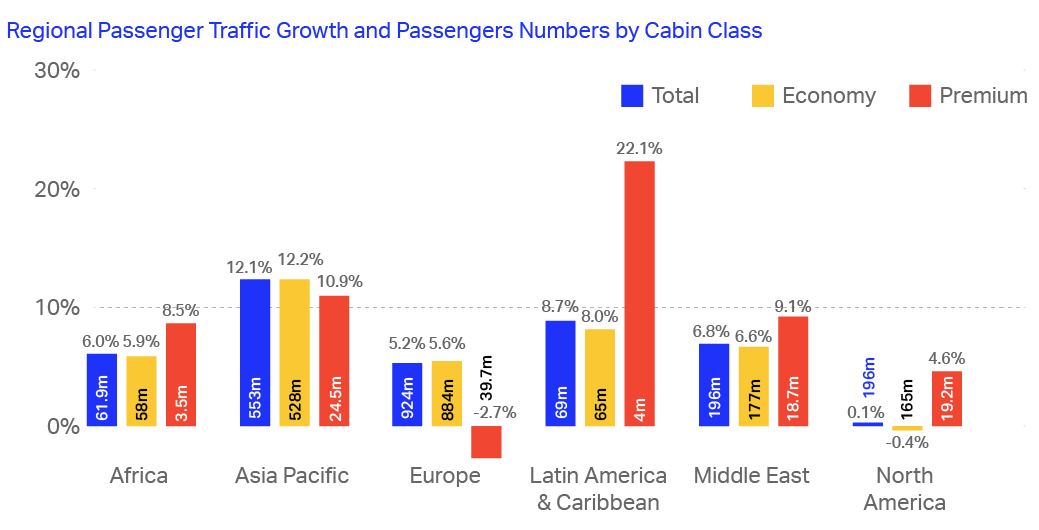
Asia-Pacific also recorded the fastest regional increase in international passenger numbers in 2025. The total rose 12.1% to 553 million, including 528 million economy-class passengers and 24.5 million premium-class passengers. Economy travel increased 12.2%, and premium travel grew 10.9%, according to IATA’s cabin-class data.
A separate IATA update published on January 29 showed that Asia-Pacific airlines increased full-year international demand, measured in revenue passenger kilometres, by 10.9% in 2025.
Capacity, measured in available seat kilometres, rose 10.2%, and the region’s international passenger load factor reached 84.4%, the highest among all regions.
Reader Conversation